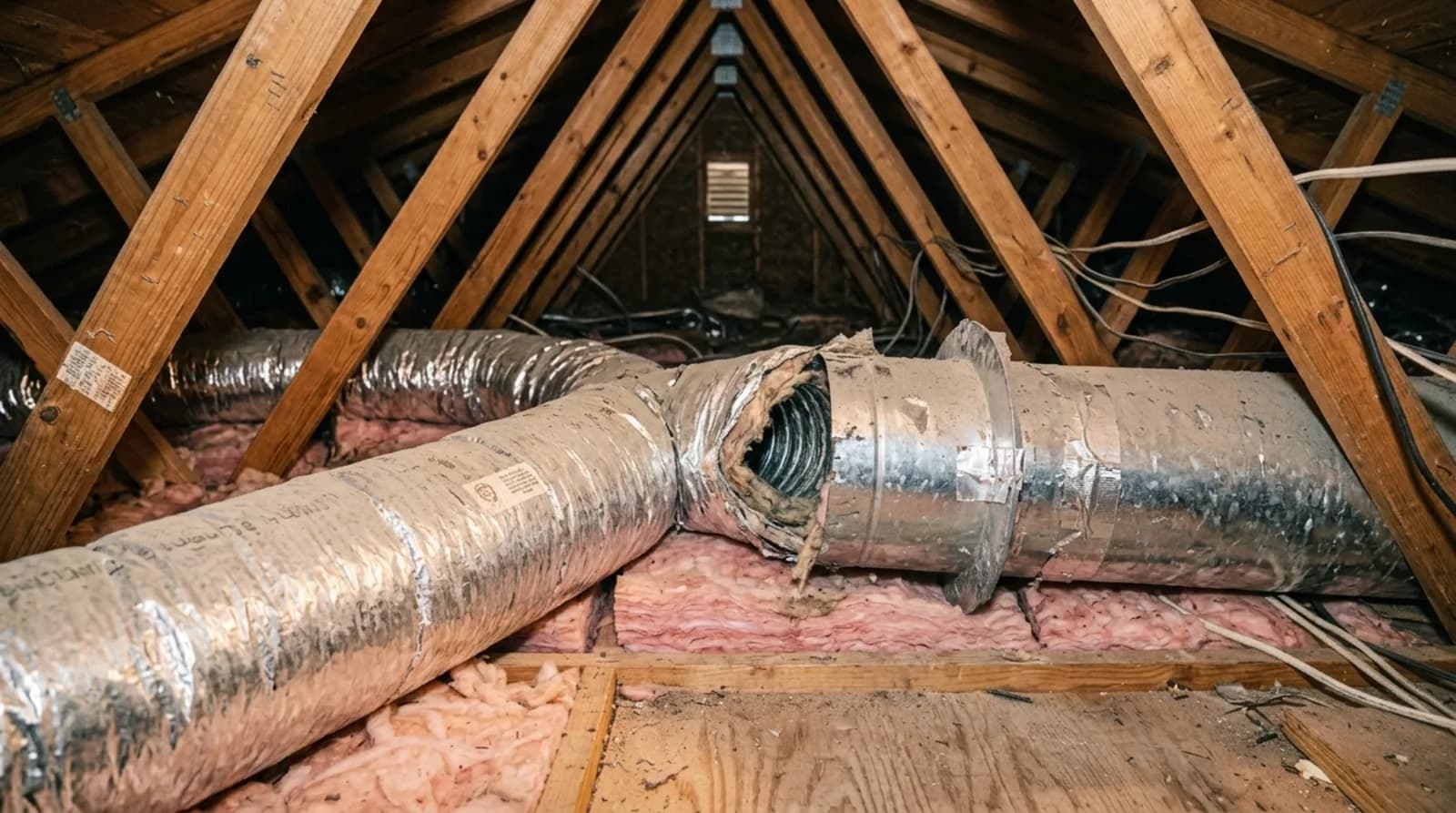
If one room in your Temecula Valley home is always five degrees warmer than the rest, the problem usually is not the air conditioner. It is the 60 to 120 feet of flexible duct running through an attic that hits 140°F on an August afternoon — and the joints in that duct system that were never properly sealed.
Duct leakage is the most under-diagnosed comfort problem in Riverside County homes, partly because it is invisible and partly because it degrades so slowly that homeowners adjust to it. It is also one of several reasons some Murrieta and Menifee homes run hotter than the neighbors. Here is what it costs and how to tell whether your home has it.
How Much Air Actually Escapes
In a typical older home with flexible ductwork in an unconditioned attic, somewhere between 20 and 30 percent of the conditioned air the blower moves never reaches a supply register. It leaks out at plenum connections, at boot-to-drywall junctions, through torn inner liners, and at collars where mastic was skipped in favor of a wrap of cloth duct tape that dried out a decade ago.
Energy Star's duct sealing guidance puts typical losses in the same range and identifies attic and crawlspace duct runs as the highest-priority targets. In our climate, attic runs are the whole story — almost nothing here has a basement.
Why It Is Worse in the Temecula Valley Than Most Places
Two local factors compound the damage. First, the temperature difference. A duct carrying 55°F supply air through a 140°F attic has an 85-degree gradient pushing heat into it across every uninsulated inch. Second, the dust. Air blowing out of a leaky supply duct is replaced by air pulled in through return-side leaks, and in the dry corridors along I-15 and I-215 that make-up air arrives loaded with fine particulate.
That second effect is why duct leakage and indoor air quality are the same conversation. Return leaks in an attic pull insulation fibers, dust, and rodent debris directly into the air you breathe — a problem worth reading about alongside why indoor air quality gets worse in winter, when homes stay closed up for weeks.
Six Signs of a Leaky Duct System
- One or two rooms never reach setpoint, usually the ones farthest from the air handler
- Registers in the back bedrooms have noticeably weaker airflow than the hallway
- The attic access hatch area feels cold when the AC runs
- Dust accumulates on furniture faster than the filter schedule seems to justify
- Summer electric bills rose year over year with no change in usage
- The system runs longer and longer each season to hold the same temperature
The Bill Impact
Duct losses translate almost linearly into runtime. If 25 percent of your cooling capacity is being delivered to the attic, the system has to run roughly a third longer to condition the living space. On a Southern California Edison time-of-use plan, where the expensive window lands squarely in the late-afternoon peak, that extra runtime is charged at the worst possible rate.
For most homes we see, sealing the accessible leaks changes the summer bill more than any equipment upgrade of similar cost would. If you are already mapping your usage against your rate plan, our post on smart thermostats on an SCE time-of-use plan covers the scheduling side of the same problem.
What Duct Sealing Involves
Real sealing is not a spray-and-pray job. The accessible work is mechanical: pull back the insulation wrap at each connection, clean the surface, apply water-based mastic to the collar and the inner liner clamp, re-tension the strap, and re-seal the outer jacket. Plenum seams and the cabinet-to-plenum junction get the same treatment, because those are the highest-pressure leaks in the system.
Boots that have pulled away from the ceiling drywall get re-anchored and sealed from above. Crushed or kinked flex runs get re-hung with proper support straps so the duct holds its rated inside diameter instead of choking down to half of it.
When Sealing Is Not Enough
Some systems are past repair. Flex duct with a torn or brittle inner liner, runs that were undersized for the equipment from day one, or a return path that was never adequate cannot be fixed with mastic. In those cases a partial or full duct replacement is the honest recommendation, and it is worth pricing it alongside equipment if the system is also near end of life.
Sizing and ducts are linked problems. A duct system that cannot deliver air will make a correctly sized condenser behave like an undersized one — the flip side of the sizing conversation.
Insulation Matters As Much As Sealing
A perfectly sealed duct still gains heat if its insulation is thin or compressed. Older homes in Winchester and Wildomar often have R-4.2 flex from an era when that was code; current practice in our climate zone is R-8. Where budget forces a choice, seal first and insulate second — leaked air is a total loss, while conduction through insulation is only a partial one.
How to Verify the Work
Ask for before-and-after static pressure readings and register airflow measurements at the worst-performing rooms. Numbers are the only way to separate real improvement from a good story. A photo log from inside the attic is reasonable to ask for too, since you are paying for work you cannot see.
Sealing ductwork is the rare HVAC improvement that makes the house quieter, cleaner, and cheaper to cool at the same time — without touching the equipment.
Where Maintenance Fits
Duct problems rarely appear overnight. Straps loosen, mastic cracks, and rodents work on insulation year after year. A recurring maintenance visit through the Comfy Club catches those changes while they are still a 20-minute fix rather than a weekend project, and it is the same visit that keeps coils and drain lines clear.
Get Your Ducts Looked At
Baker Air Inc. is a family-owned HVAC contractor serving Temecula, Murrieta, Menifee, Wildomar, Winchester, and Lake Elsinore. California Contractor License #1098493. If you have a room that never cools or a bill that keeps climbing, we will inspect the duct system and tell you plainly whether sealing, insulating, or replacing is the right call — call (951) 348-0686 or book a visit online.
If the airflow problem turns out to be a failing blower, capacitor, or coil rather than the ducts, our same-day repair team can handle it on the same trip. For rooms that no duct system will ever serve well — converted garages, back offices, additions — a ductless mini-split is often the cleaner answer.
Written by
The Baker Air Team
Family-owned HVAC contractor · Winchester, CA · CSLB #1098493