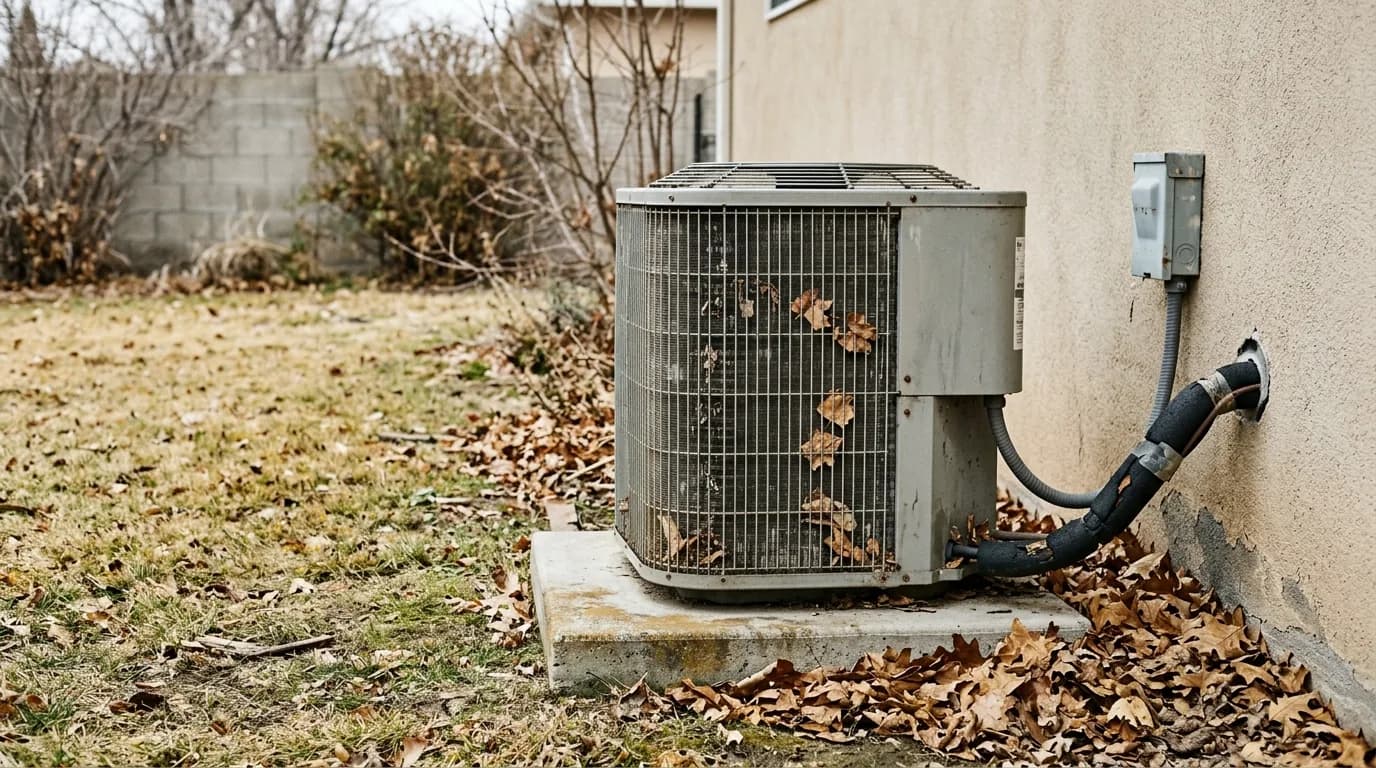
In the Temecula Valley, no — do not wrap your condenser for the winter. A full cover traps moisture against the coil and the electrical components, and it turns a sheltered metal box into exactly the kind of place rodents want to spend January.
The advice to cover a condenser comes from climates with heavy snow and ice loading. We have neither. What we have is mild damp mornings, a lot of leaves, and a rodent population that will happily chew wiring insulation if you give them a dry roof.
Why Full Covers Cause Problems Here
- Trapped moisture. A condenser is designed to be open to the air and to dry out. Seal it under a non-breathable cover and condensation collects inside, which accelerates corrosion on the coil, the cabinet and the electrical contacts.
- Rodent habitat. A covered unit is dry, dark and sheltered. Chewed low-voltage wiring and nests inside the cabinet are a routine spring finding, and the repair is not trivial.
- Forgetting it is there. On a heat pump this one matters enormously, because the outdoor unit runs in winter. Running a covered heat pump damages it quickly.
- It does not prevent much. The components you are trying to protect are already rated for outdoor exposure.
What Is Actually Worth Doing
- Clear debris from around the unit. Leaves, trimmings and overgrowth within two feet of the cabinet restrict airflow and hold moisture against it.
- Rinse the coil with a gentle hose spray from the inside out if you can access it, or just from the outside. No pressure washer — the fins bend easily and bent fins permanently reduce capacity.
- Check that the pad is level and has not settled. A tilted unit stresses the refrigerant lines and the compressor mounts.
- Look at the line set insulation. The foam sleeve on the larger refrigerant line degrades in UV and goes brittle. Replacing it is inexpensive and it directly affects efficiency.
- If you want a cover, use a lid-style top cover only — one that shields the top of the unit from falling debris while leaving all four sides fully open.
- Do not shut off the outdoor disconnect if you have a heat pump. Some units have crankcase heaters that need power through the winter.
That last point catches people with newer systems. If you are unsure whether your outdoor unit runs in winter, check whether your system has a furnace at all — if the heat comes from the same outdoor unit, it is a heat pump. Our comparison of heat pumps against AC and gas furnace setups explains the difference.
The Rodent Problem Deserves Its Own Paragraph
We open condensers every spring that have been nested in over the winter. The damage is almost always to the low-voltage control wiring and occasionally to the compressor contactor. It presents as a system that simply will not start on the first hot day, which is the worst possible time to discover it.
Keeping the cabinet uncovered, the surrounding area clear, and vegetation cut back is most of the prevention. If you have had rodents before, a hardware cloth screen around the base — installed so it does not restrict airflow — is better than a cover.
End of Cooling Season Is Also a Good Time to Assess
You have just finished five months of hard running, so the system's weaknesses are fresh. If it struggled this summer — long run times, rooms that never caught up, a capacitor replaced, rising electricity bills — that is information worth acting on in the off season rather than next June.
Fall and winter are the quiet months for HVAC work, which means better scheduling and no emergency premium. Our post on why fall is the best time to replace an AC makes that case, and if the summer problem was uneven cooling rather than the equipment itself, leaky ductwork is the more likely cause.
The Short Version
- Do not wrap the condenser
- Clear debris, rinse the coil gently, cut vegetation back
- A top-only lid is acceptable; a full wrap is not
- Leave power on if you have a heat pump
- Book any deferred work now while scheduling is easy
Serving the Temecula Valley from Winchester. Call (951) 348-0686 or book preventative maintenance through our contact page.
Written by
The Baker Air Team
Family-owned HVAC contractor · Winchester, CA · CSLB #1098493